Building in New Orleans: What Working Outside the Tech Bubble Actually Feels Like
Twelve years running an indie studio outside the SF/NY ecosystem. What that costs, what it quietly gives you, and why I'm still here.
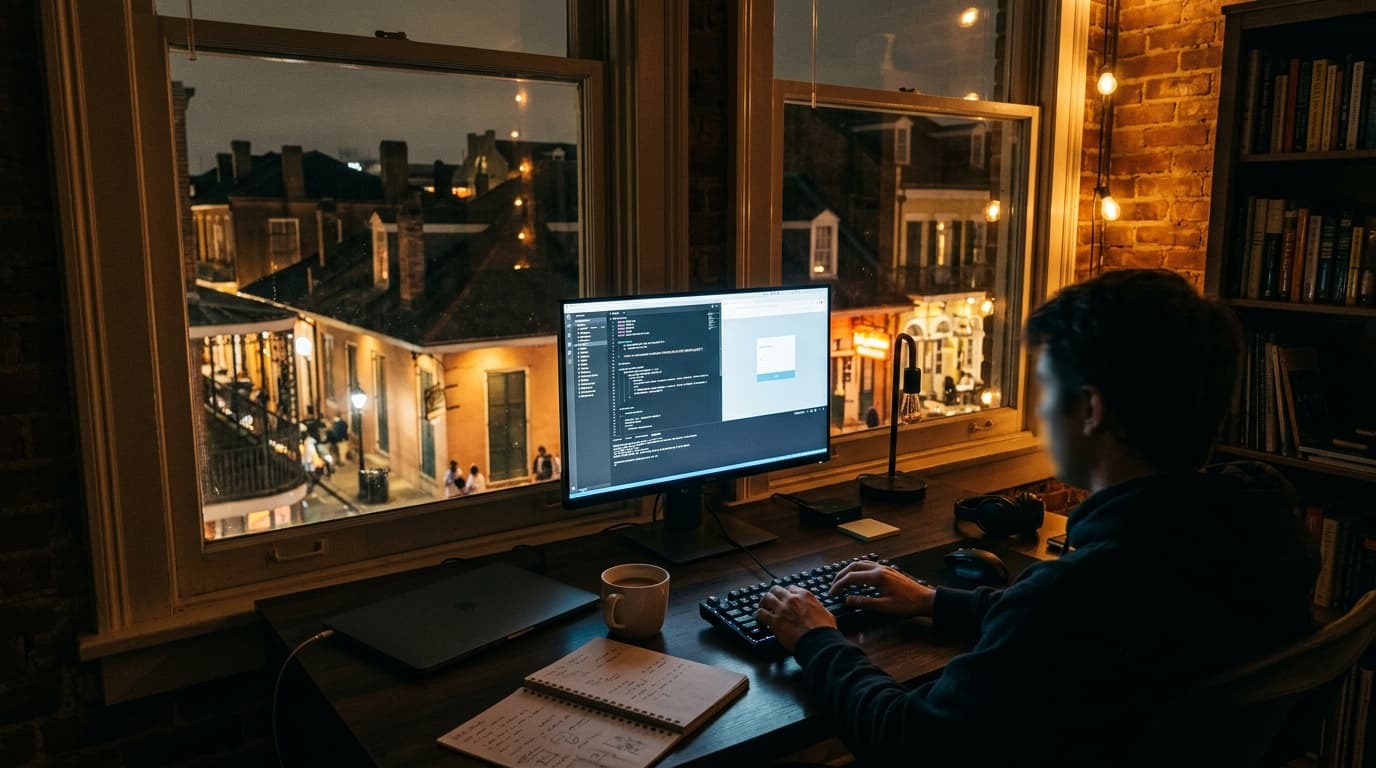
XenneX has been based in New Orleans since 2014. I've never seriously considered moving it.
People find that surprising. The assumption is that a software studio should be somewhere with a tech scene — San Francisco, Austin, New York, maybe Miami now. Somewhere you can walk into a coffee shop and accidentally sit next to someone who could become a co-founder, a client, or an investor.
New Orleans is not that place. I want to be honest about what that costs.
What You Actually Give Up
The network effects of a real tech hub are real. I don't have them.
There's no casual overlap with other founders. No serendipitous introductions at events where everyone in the room is building something. No investor community that knows the local landscape and takes warm intros seriously. When XenneX has needed capital, technical advisors, or specialized talent, I've had to find all of it remotely and cold — which is possible, but consistently slower and harder than it would be somewhere else.
The talent pipeline is thin. New Orleans has universities, and they produce good engineers, but the ones with ambitions to join a startup usually leave. The city doesn't retain tech talent the way it retains musicians, chefs, and filmmakers. That's a real structural problem if you want to grow a team.
And there's the credibility gap. I've had conversations with potential clients and partners where the New Orleans address registers as a yellow flag. Not a deal-breaker, but a question mark — are you serious? The burden of proof is slightly higher when you're not where people expect serious software companies to be.
What You Quietly Get
Here's what I didn't expect: being outside the ecosystem has made XenneX more itself.
The pressure to pattern-match doesn't exist here. In SF, there's a gravitational pull toward certain kinds of companies — VC-backed, high-growth, specific verticals, specific hiring profiles, specific exit narratives. It's not explicit. It's ambient. Everyone around you is building a version of what's fundable right now, and that shapes how you think about your own company even when you're trying to resist it.
I don't have that pressure. XenneX has always been able to build what made sense to build — not what fit a current thesis. Some of those bets were wrong. But they were our bets, and the portfolio reflects what we actually believe, not what the market was rewarding in 2021.
The cost of living difference is also real and underappreciated as a strategic asset. Lower burn rate means more runway. More runway means less pressure to force a decision or take a deal that isn't right. I've watched founders in higher cost markets make decisions I knew they didn't want to make because they didn't have the time to wait for a better one.
New Orleans is cheap enough that XenneX has never had to compromise because of time pressure alone. That's worth more than people think.
The Remote Infrastructure Was Necessary Early
Building outside a tech hub forced me to figure out remote collaboration years before the rest of the industry had to. Every contractor, every partner, every extended team member has always been somewhere else. The tooling, the communication norms, the project management practices — I had to build those intentionally from the start because I couldn't rely on people being in the same room.
COVID didn't change how XenneX operates because there was nothing to change. We were already distributed. The companies that struggled to adapt to remote work in 2020 were catching up to something we'd been doing by default since 2014.
That's not foresight. It was necessity. But the outcome is the same.
Why I'm Still Here
The honest answer isn't romantic. I'm still here because this is where my life is, and I've found a way to build a real company from it. That's the whole answer.
New Orleans gives me something no tech hub offers: a city that has nothing to do with software. The conversations I have here, the culture I live inside, the problems I see that need solving — none of it is shaped by the industry I work in. That separation keeps me thinking more clearly about what actually matters, which is not always obvious when your entire environment is the industry.
XenneX is a better company for being built here. I believe that. I'm also clear-eyed about what it costs.
Both things are true, and you can hold them together.
Working on something like this? See how XenneX works with clients or what XenneX has built.
Keep reading
- Why I Build Many Things Instead of One ThingThe conventional advice is to focus. I've spent 12 years doing the opposite. Here's why the portfolio approach works for this studio — and why I'd make the same bet again.
- I've Been Building Software for 12 Years. Nion Lights Is Trying to Change That.The mental model shift from software to hardware is steeper than I expected. Here's what I'm getting wrong.
- The Actual System I Use to Ship 6 Products Without a Team.Not a philosophy piece. The literal mechanics — what runs on what schedule, how triage decisions get made, and which products mostly run themselves.